Showing posts with label Iceland. Show all posts

Saturday, May 19, 2018

Ryan’s take: My horse was just hungry

Hrodlur, right, after surviving my maiden ride.
“It’s just like riding a bike,” one of the guides said as we mounted our horses.

It’s not.

In fairness, I think she was referring to the positioning of our feet in the stirrups – similar to where they should be on a bike pedal. That’s where I would say the similarities end.  

Hrödlur, my horse, tested me early on, as Elizabeth reported. We had to stop because someone (Elizabeth) was falling too far behind. And when we stopped to wait for that person (Elizabeth) and her horse to catch up, Hrödlur decided that was his chance to see how much he could get away with. Or else decided to wander off for a snack. Regardless of the reason, he turned right … and kept going.

I tried to tell him not to, but I’m pretty sure he was annoyed that I couldn’t pronounce his name.

Meanwhile, I’m looking for the handle bars or steering wheel or brakes. I’m pulling the reins and trying to remember whether my legs should be out to slow him down (they should) or whether I should squeeze him with my legs (I should not). I’m sure I was squeezing.

Finally, he relented and returned to the line after a combination of the guide yelling, no immediate grass for Hrödlur to eat where he took us and my bargaining with Hrödlur as I flailed around with my arms with the reins and my legs.
Eating ... again. 

After that, I’m proud to say we got a long swimmingly. Hrödlur did all the work, and I tried my best to stay on the saddle when we went faster.

But every time we stopped, Hrödlur jerked his head down and started eating anything he could.

Even if we stopped for just a second (usually to let Elizabeth catch up), Hrödlur went straight for the ground to munch.

Our guide said Icelandic horses eat at every chance they get because they have learned over generations to conserve energy both by eating a lot and limiting excess movements. Icelandic horses are smaller than American or European horses – but are larger than ponies. Note: Several souvenir shops sold t-shirts and coasters with cartoon Icelandic horses with annoyed expressions saying: I’m not a pony.

They’re also fiercely protected. No horses can be brought onto the island and once an Icelandic horse leaves the island, such as for a competition, the horse can never come back so as not to introduce any diseases. Even saddles used on horses outside Iceland aren’t allowed.


But these are a hardy bunch of horses who handle cold weather and steep hills all in stride.
The (semi)successful riders. 

Elizabeth on horses: Why Milla reminded me that I should never be in charge

And they're off!
Despite living for 13 years in Kentucky and covering seven Derbys, Ryan got his first hands-on experience with a horse on our trail ride with Icelandic horses.

I may have had the "expertise" – if that terms applies after passing a one-credit horseback riding course in college - but we were definitely the problem children for our instructor.


Ryan was aboard Hrodlur. Our troubles began about three minutes after mounting the horses. Picture three horses standing placidly in line behind the tour leader, then me about 15 feet behind, and then Ryan and Hrodlur 50 yards away while the guide yells "Mister, mister! Pull to the left!" Finally, Ryan convinced Hrodlur to return to formation. After that rocky start, Hrodlur calmed down wonderfully.
Snack break/photo break. 

Then there was me. Feisty is a deft description for my horse, Milla. She wanted to set her own pace rather than keep up with group, prompting many "Keep up! Closer! Closer!" directives from the guide.

Just a snack break. 
If we stopped for even a second, Milla was eating. Getting her to stop eating was a struggle. She'd make her own path when food was an option, and had no concern for whether her rider wanted to walk through that particular clump of bushes or where the other horses were going.

And when our group of six elected to speed up the pace, Milla wasn't content to follow the pack - she wanted to race for the lead and picked off the others. The instructor kept yelling "Shorten the reins!" and everyone knew she was most worried about me and Milla.

As we neared the end of the ride, even the instructor seemed to have given up on our cooperation. Milla and I were still trailing the pack by about 10 feet. I watched as the other four riders guided their horses into the paddock and readied to dismount. Milla, however, stopped a foot in front of the paddock and refused to move. I looked to the instructor in a panic, but by then even she was grinning: "Sorry, she's pooping. Give her a second."

Photos cannot do the setting justice. 
It illuminated why Sydney dog determines her walking routes, dining schedule, and wake-up times.
You know, basically running our household. The formidable will I inherited from my grandmother is apparently no match for any adorable animal, no matter the size.

Friday, May 18, 2018

Eating like a native (Ryan more so than me)

Ryan begin practicing for his eventual Amazing Race audition by trying several authentic Icelandic dishes during our stay:
  • Fish stew (mashed fish and potatoes on rye bread)
  • Smoked lamb on a thin crepe
  • Dried fish (think jerky)
  • Smoked trout and cottage cheese on rye
  • Hard-boiled egg slices and pickled herring on rye
  • Fermented shark followed by the cursory shot of Black Death
Our very kind waitress is on her way with the shot of Brennivin (Black Death) to help Ryan chase the fermented shark.
Admittedly, the pickled herring was technically part of my platter, and I simply couldn't eat more than a single bite. The texture was too slimy and jellyish-like. So Ryan had to finish that for me (though I didn't give up any of Cafe Loki's delicious house-made rye bread - so good they put its crumbles in ice cream).

Elizabeth is excited to dig into her mashed fish. A few minutes later, she was not that excited about the pickled herring. 

Other dishes I sampled was Skyr, which seems like yogurt, but Wikipedia says is actually cheese, and star-shaped lemony waffles (for I couldn't find an official name).

Not surprisingly, we skipped the optional dose of cod liver oil available at the hotel breakfast buffet after seeing this photo at the Reykjavik Museum of Photography.

Wednesday, May 16, 2018

Iceland rocks! (with bonus Rush reference)

On the way to Reykjavic from the Keflavic Airport, I noticed large towers of deliberately stacked rocks, which, from a certain angle and distance, looked as if they had the silhouettes of people.

What a strange and cool welcome, I thought.

Then we just kept seeing them them. The rocks – many, if not all, are volcanic – seemed magically stacked or at least magically balanced.

A small tower of rocks in front of more stacks that we found on our walk along the Reykjavic seashore. 
These reminded me of Celtic cairns we had seen in Ireland. (For Rush fans, they also reminded me of the cover of the band's 1996 album, "Test for Echo.")
Courtesy: Rush.com

But clearly Icelandic cairns are a thing. Only here, they're called:Vörður, which comes from the Old Norse word varða that means "to guard," according to the Online Etymology Dictionary. (Side note for pronunciation: the ð takes on a th sound.)

So what are they guarding in modern day Iceland? Sometimes the sea. Or the shore, depending on your perspective. The rocks along the harbor in downtown Reykjavic were filled with ones like these:


More stacks and carefully arranged piles of rocks. 

Elizabeth got a shot of me trying to memorialize this geo-trend. 
But when it comes to rocks, that's not all.

Santiago Sierra, a Spanish artist created the monument below of a boulder split by a metal cone, which stands across the street from the Iceland Parliament building like some watchful or omniscient sentiment. Sierra installed the monument in 2012 in the wake of protests over the financial crisis in 2008-09 in Iceland, which was hit hard.  For more on this, Icelandic journalist Snorri Pall Jonsson Ulfhildarson wrote a pretty comprehensive think piece about the complexity of and questions raised by the monument.


The rock's sign plate quotes the "The Declaration of the Rights of Man and of the Citizen" of 1793 aimed at echoing sentiments from the French Revolution: "When the government violates the rights of the people, insurrection is for the people and for each portion of the people the most sacred of rights and the most indispensable of duties."


Of course, not all rocks have to be spit from volcanos, stacked in magical towers or split in half for political/civic monuments. Sometimes they're just good to stand on. 

Elizabeth had to buy a hat. It wouldn't be an international trip if we didn't misjudge the weather a little. 


Tuesday, May 15, 2018

Embracing #MyStopover in Iceland

Our 2018 vacation has commenced. On the agenda this year are Iceland, Scotland and France.

We're in the first of those countries now – our first time visiting Iceland. We traveled via Icelandair and bought into the company's highly effective #mystopover marketing campaign. Icelandair is definitely not afraid to position itself as a quirky brand.

Ryan and I watched the airline's safety video with mouths agape. This shot pretty much sums it up, though you can watch the entire video on YouTube.


Another marketing channel(?) that Icelandair has embraced: the airsickness bag.

The airline has claimed this previously underutilized real estate to explain "loftslag" or the reason that Iceland has such a variable climate. Ryan, however, couldn't see that from his seat.

Ryan: What's that?
Me: The barf bag.

Two minutes later.

Ryan: Are you still reading that?
Me: Yes. It's actually interesting.
Ryan: Seriously? Beyond "Aim into the opening" how thorough do the instructions need to be?

Really, it's so much more than just a vomit receptacle.


Friday, July 1, 2016

Interview with a cab driver: Making sense of Irish sports edition

When taxi drivers in the United States discuss hurling, it's usually in the context of "please don't inside the cab."

In Ireland, it's more likely that the topic is the sport of hurling (although the former still applies.)

Early on during my studies in Ireland, we had to take taxis from the University College Dublin one afternoon because a marathon had shut down the main road and all bus service from UCD. As a result, I and the others in the taxi were treated to an incredibly valuable introductory tutorial about Irish sports – and diplomacy – from our cab driver, Michael.

A shot of a hurling match we watched at Galway pub.
For instance, he called hurling the "fastest game on turf" – a brilliant blend of lacrosse, football (soccer), field hockey, rugby and possibly a few other sports thrown in there too. The sticks looked like sawed off field hockey sticks and they can whip a baseball-sized leather ball at 90 mph. There is some combination of passing and blocking and scrum-like pile-ups. And a team can score by hitting the ball through field-goal uprights (one point) or into a soccer-like goal below the uprights (three points).

He wasn't kidding. While we were in Galway, a group of us went to a pub and caught the second half of a hurling match between Dublin and Kilkenny after which I decided the sport got its name from the fact that bats, balls and elbows are being hurled in all directions all the time. The field is huge and the players will randomly hit the ball toward the uprights from literally anywhere on the field. One Kilkenny player cracked one from three-quarters of the field away dead-center through the uprights. There are rules about passing and dribbling that I don't understand yet.

Even if the TV weren't blurry, I still would struggle to explain it.
The other prominent Irish sport is Gaelic football. Like hurling, it's played with a soccer goal/field goal combination (one point for kicking the ball through the uprights, three points for a goal).

The scores in both sports, by the way, require some math because the format separates goals from field goals. For instance, in the Dublin-Kilkenny hurling match, Kilkenny had 1-25 (one goal and 25 field goals) to Dublin's 0-16. So actually, Kilkenny won in points 28-16. It took us a while to figure that out.

In Gaelic football, the rules about dribbling and passing and how many steps you can take are equally obtuse.

Michael, our cab driver, played for Dublin's top club, the Kilmacud Crokes and said some of the sport remains a mystery to me. "I played for nearly 30 years, and I still don't understand all the rules," he said. All the Gaelic football and hurling players are amateurs, he said. "But they're totally committed and train as hard as any pro player," Michael told us.

Gaelic football looks a lot like rugby at first, but there are fewer scrums and it seems to put a premium on good passes and the finesse of soccer rather than tackling and blocking of football or rugby.

The two sports experienced a renaissance in Ireland in the late 1800s as Irish nationalism increased. The Gaelic Athletic Association formed as a way to further promote these truly Irish sports and, thus, Irish culture. But for nearly a century, the rules about participating in the GAA were particularly strict. Michael told us that when he was a young player, GAA members were forbidden from playing non-Irish sports, such as rugby or soccer. If they were caught participating in some "foreign" sport, they'd get kicked off their GAA team.

"I still played all the sports anyway," Michael said. "I believe sports are meant to unify, not divide."

So I asked Michael, our philosopher/diplomat/cab driver, whether he and other Irish sports fans root for or against England in big tournaments, such as the Euro 2016 football tournament that's been going on this month.

He laughed. It's a rivalry, he said. "If Ireland were playing England in chess we'd all watch it," he said.

Michael said he has an English friend who roots for Ireland if England isn't playing and once asked him if Michael would root for England after Ireland was eliminated in a European tournament. Michael told him that he would support England right up to the championship game and then would root for the Brits to lose. "It's like big brother versus little brother," he said. And the little brother is tired of seeing the big brother win everything.

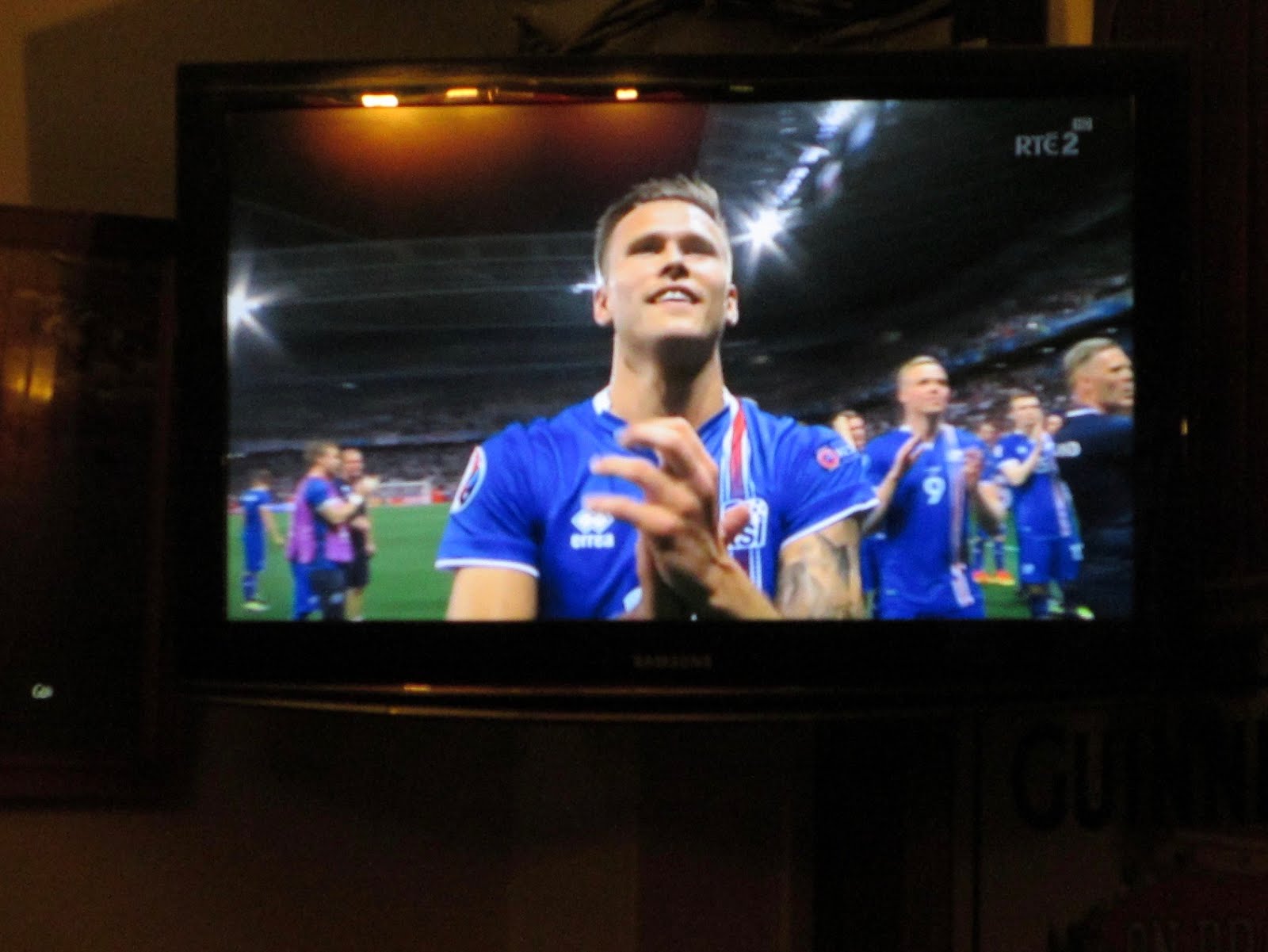
But what we've found is that not everyone in Ireland is as generous toward English teams. In fact there was more than a bit of schadenfreude Monday night when England played Iceland in the round of eight of the Euro 2016 championship – a match that Iceland went on to win 2-1. Murphy's Pub in Dingle erupted in cheers as the clock ran out on England.

Iceland, which has more volcanoes than people as the commentators kept pointing out, celebrated its upset in style.
My only regret is that we didn't get to see any matches in person, which I contend is a worthy excuse to have to return to Ireland one day.