Showing posts with label European Championships. Show all posts

Friday, July 1, 2016

Interview with a cab driver: Making sense of Irish sports edition

When taxi drivers in the United States discuss hurling, it's usually in the context of "please don't inside the cab."

In Ireland, it's more likely that the topic is the sport of hurling (although the former still applies.)

Early on during my studies in Ireland, we had to take taxis from the University College Dublin one afternoon because a marathon had shut down the main road and all bus service from UCD. As a result, I and the others in the taxi were treated to an incredibly valuable introductory tutorial about Irish sports – and diplomacy – from our cab driver, Michael.

A shot of a hurling match we watched at Galway pub.
For instance, he called hurling the "fastest game on turf" – a brilliant blend of lacrosse, football (soccer), field hockey, rugby and possibly a few other sports thrown in there too. The sticks looked like sawed off field hockey sticks and they can whip a baseball-sized leather ball at 90 mph. There is some combination of passing and blocking and scrum-like pile-ups. And a team can score by hitting the ball through field-goal uprights (one point) or into a soccer-like goal below the uprights (three points).

He wasn't kidding. While we were in Galway, a group of us went to a pub and caught the second half of a hurling match between Dublin and Kilkenny after which I decided the sport got its name from the fact that bats, balls and elbows are being hurled in all directions all the time. The field is huge and the players will randomly hit the ball toward the uprights from literally anywhere on the field. One Kilkenny player cracked one from three-quarters of the field away dead-center through the uprights. There are rules about passing and dribbling that I don't understand yet.

Even if the TV weren't blurry, I still would struggle to explain it.
The other prominent Irish sport is Gaelic football. Like hurling, it's played with a soccer goal/field goal combination (one point for kicking the ball through the uprights, three points for a goal).

The scores in both sports, by the way, require some math because the format separates goals from field goals. For instance, in the Dublin-Kilkenny hurling match, Kilkenny had 1-25 (one goal and 25 field goals) to Dublin's 0-16. So actually, Kilkenny won in points 28-16. It took us a while to figure that out.

In Gaelic football, the rules about dribbling and passing and how many steps you can take are equally obtuse.

Michael, our cab driver, played for Dublin's top club, the Kilmacud Crokes and said some of the sport remains a mystery to me. "I played for nearly 30 years, and I still don't understand all the rules," he said. All the Gaelic football and hurling players are amateurs, he said. "But they're totally committed and train as hard as any pro player," Michael told us.

Gaelic football looks a lot like rugby at first, but there are fewer scrums and it seems to put a premium on good passes and the finesse of soccer rather than tackling and blocking of football or rugby.

The two sports experienced a renaissance in Ireland in the late 1800s as Irish nationalism increased. The Gaelic Athletic Association formed as a way to further promote these truly Irish sports and, thus, Irish culture. But for nearly a century, the rules about participating in the GAA were particularly strict. Michael told us that when he was a young player, GAA members were forbidden from playing non-Irish sports, such as rugby or soccer. If they were caught participating in some "foreign" sport, they'd get kicked off their GAA team.

"I still played all the sports anyway," Michael said. "I believe sports are meant to unify, not divide."

So I asked Michael, our philosopher/diplomat/cab driver, whether he and other Irish sports fans root for or against England in big tournaments, such as the Euro 2016 football tournament that's been going on this month.

He laughed. It's a rivalry, he said. "If Ireland were playing England in chess we'd all watch it," he said.

Michael said he has an English friend who roots for Ireland if England isn't playing and once asked him if Michael would root for England after Ireland was eliminated in a European tournament. Michael told him that he would support England right up to the championship game and then would root for the Brits to lose. "It's like big brother versus little brother," he said. And the little brother is tired of seeing the big brother win everything.

But what we've found is that not everyone in Ireland is as generous toward English teams. In fact there was more than a bit of schadenfreude Monday night when England played Iceland in the round of eight of the Euro 2016 championship – a match that Iceland went on to win 2-1. Murphy's Pub in Dingle erupted in cheers as the clock ran out on England.
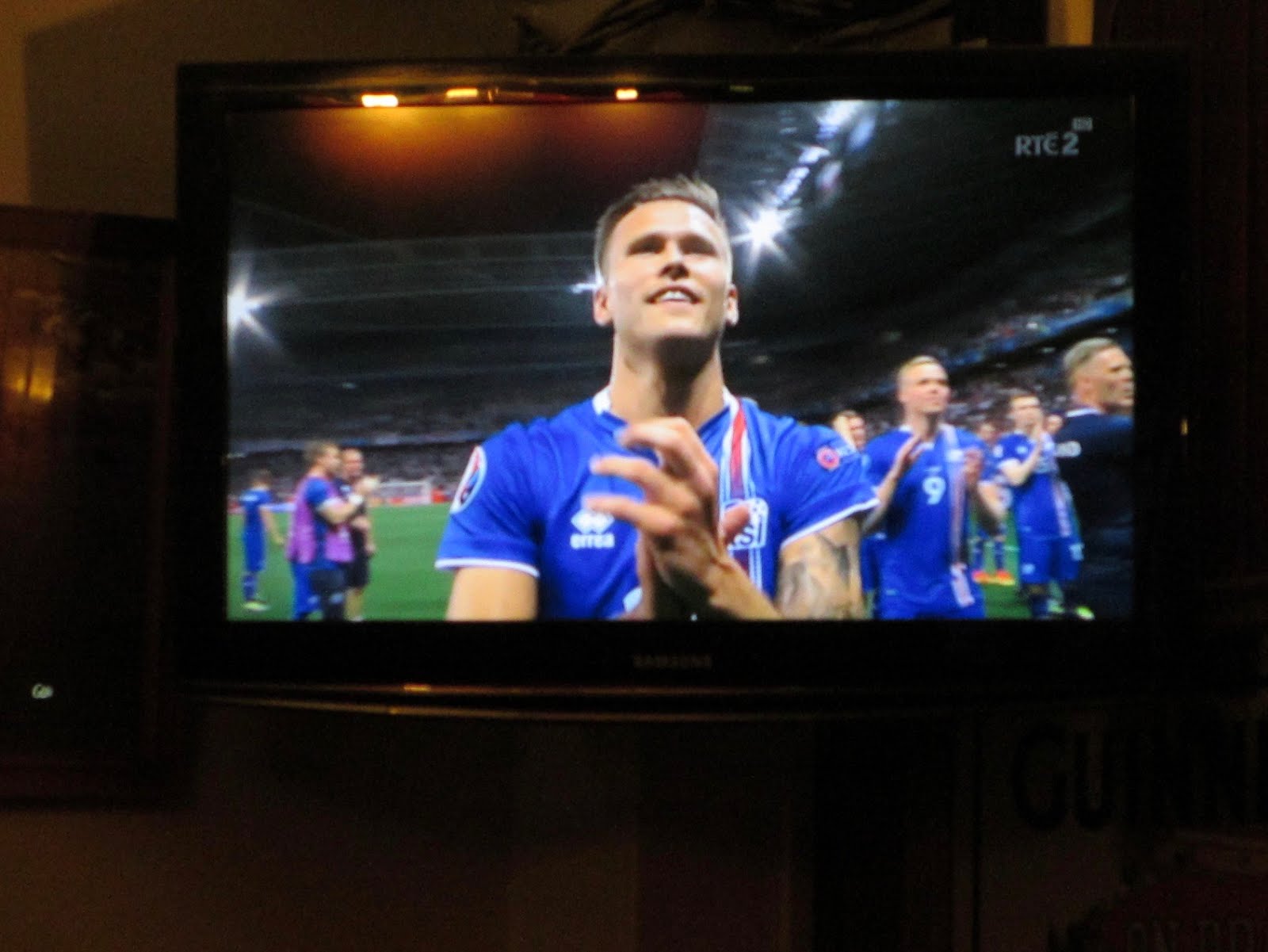
Iceland, which has more volcanoes than people as the commentators kept pointing out, celebrated its upset in style.
My only regret is that we didn't get to see any matches in person, which I contend is a worthy excuse to have to return to Ireland one day.

Thursday, June 23, 2016

Around town: Randomness of a Belfast Saturday


The view of a Belfast street.
Sometimes not having a plan means stumbling onto parades, passionate football fans, anime and comic characters, as well as inventive seagulls and water skiers. In other words, you never know what you're going to find when wandering around a city (or perhaps just Belfast.)

Q-Con in action.
Five of us set out on foot last Saturday for downtown Belfast with only a rough plan for the day. We knew we'd stop by St. George's Market to check out the food and music and explore the city, which despite the tensions, has enjoyed a tourism and economic revival since the peace agreements.

Beyond having a rough direction to walk, the rest would be up to serendipity.

And serendipity delivered in a kind of Alice in Wonderland way where everything seemed to get curiouser and curiouser. 

First, as we passed through the center of Queens University, we started noticing people in colorful wigs and costumes. It turns out, this was Q-Con, Queens University's answer to Comic-Con. It offered a weekend's worth of anime screenings, social activities (such as Pints Against Humanity) and a concert by the Irish Video Game Orchestra.

When we arrived at St. George's market after a 25-minute walk, most of us were hungry enough to test out the crepes, pastries and coffee for sale.

(From left) Peter Murphy, Jason Spann, Mary Hays, Derek Stine and I take in the market while a musician (playing a mix of traditional Irish music and James Taylor songs) entertains the crowd.
Not sure what the puffy rock thingy is.
In addition to finely prepared foods and fresh seafood, it also boasted a healthy array of veggies of fruits of all sizes and colors.

We split up from there as Mary and Peter decided to walk back to the Botanic Gardens near the university. Jason, Derek and I walked back into town where crowds already assembled for a parade that started at noon.

"We'll just wait around and check it out," we collectively decided.

Once the parade got going, it was an endless stream of regiments and divisions from Ulster that fought as part of the British Army in World War I, as well as other Protestant loyalist groups.

This went on for 20-30 minutes.
Many of them marched to their own beats. And because Jason was a percussionist in Murray State's Racer Band, he offered an interesting critique about their techniques.

"The drumming was terrible," he said flatly.

Some drummers in the same group were using opposite hands, which he said made it look discombobulated. He pointed it out to me. I couldn't tell.

Others carried – or drove – with big guns. The forces from Ulster got hit hard in World War I, particularly the Battle of the Somme in France, which was supposed to be a major offensive campaign for the Brits and the French. But it quickly turned costly for the Brits after the French diverted many of their men to reinforce Verdun.

"Everything went wrong that day," as one soldier from the 36th (Ulster) Division put it.

This World War I era soldier surveys modern day Belfast before the parade begins.

After the parade, the randomness of the day only increased.

How does a seagull fix dinner? She dives for a mussel, carries it to a stone walkway and drops it from about 20 feet in the air to break it open. Then she dines. 
A leprechaun with a "Frozen" backpack? What's going on here? We would soon find out. 


Yes, she is waterskiing around the docks of Belfast with a pulley system.
This is where the leprechaun with the "Frozen" backpack was going. Outside the Titanic Museum, they had set up a stage with a giant screen ("The biggest in Ireland" the sign boasted) to show the Republic of Ireland play Belgium in the European Championships. Jason and I watched the first half, which was good for Ireland. It was 0-0. Then the second half happened. It did not go well, and Ireland lost 3-0. 

We tried to watch the end of the match in this pub, the Cuckoo near Queens University, but the sign on the door said: "No sports jerseys allowed inside." That should have tipped us off. Instead, the bar is decorated with women's underwear and wrestling action figures. Of course. 

Jason and I eventually found another pub to finish watching the night matches, including the Gaelic football championships in which Galway came back to defeat Mayo in a stunner. In all, we did another 8-9 miles. Here's a rough estimate of how far/where we walked:

The circle at the bottom is where our dorm was. The Titanic Museum with the screen for the soccer match is at the top right of the map.