Showing posts with label york. Show all posts

Tuesday, July 10, 2012

Our girly day: Shopping, sugar and high tea

America has Goodwill shops, but in Britain just about every charity has its own shop where its sells second-hand items - mostly clothes, but lots of shoes, books and household goods, too. These appear to be the big fund-raiser for most of the charities (not all of them benefit from long-ago bets on Roger Federer to win seven Wimbledon championships). A few of the shops we've visited: Pets in Need of Vets, Age Scotland, the British Heart Foundation, Cancer U.K., Autism and a few aimed at women's and children's aid. In Edinburgh, Nicholason Street is home to several of these shops, and York has a handful, too.

Charity shop row: A shop for Oxfam, one for the British Heart Foundation, a children's aid group are all visible in the shot from York. Up the street were three others. 


Ryan in particular loves stoping in these places. I think he's bought a whole new wardrobe in them (OK, maybe it's only two shirts and a sweater, but that's a lot for him in a three-day period.) We also got this deliciously creepy book at a shop in York, which is supposed to be the most haunted place in the world. It includes stories from Charles Dickens, Wilkie Collins and Bram Stoker among others.

Ryan's newest addition to our library. 


Sugar shacks: Yorkshire is apparently well known for its sweets, being the U.K. home of Nestle. There are several candy shops here and a few smaller chocolatiers. What I find funny is that the shops consistently advertise Lucky Charms cereal in their displays. I've been telling Ryan for years that they're nothing but breakfast candy, and I am claiming this as evidence that I have won this argument. No further appeals.


Other popular imports?


Tea! We did afternoon tea on Tuesday at Grays Court, which is one of the oldest continuously occupied houses in the United Kingdom, according to its website. Parts of the house date to 1080. It is now a boutique hotel that would make a fantastic spot for a wedding. We sat in the Sterne Dining Room overlooking the garden. In my excitement, I forgot to take a photo of the tea tray in my excitement, but it was a beautiful room with quite a view.

The courtyard  and entrance at Gray's Court.


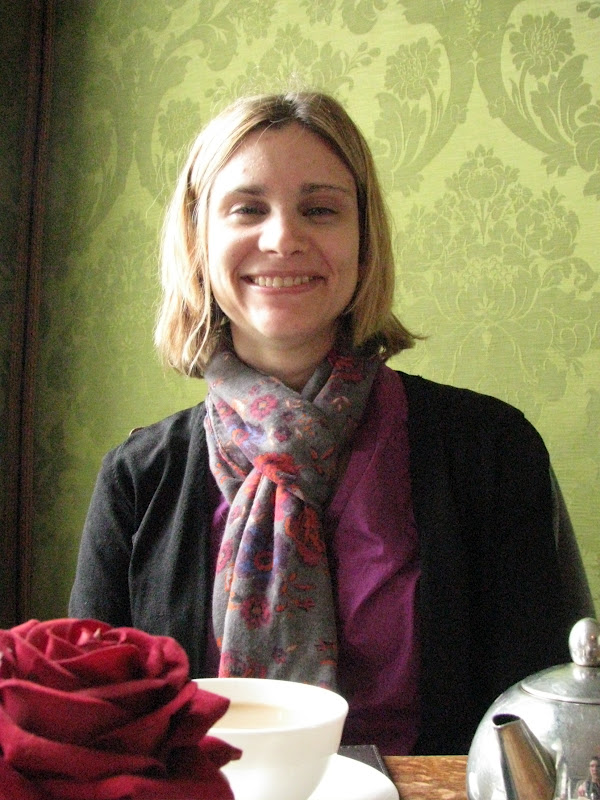
Awaiting my tea. I chose English Breakfast (you can't ever go wrong with that).


The Sterne Dining Room at Gray's Court.


Ryan preparing his tea, an Assam blend. 


The garden behind Gray's Court. 


Sign of the day: York residents wanted this sign repainted because it's a bit of a landmark, although the parent company is trying to distance itself from the product, which is no longer for sale.

Ryan's comment: Sounds like something from Harry Potter.


Beer of the day: Ryan tried several new beers on Tuesday night while we were blogging. The first was a John Smith, which sounds like it is the PBR of this country. He also had an Abbot's that he rather liked.


Working on the blog at Cross Keys in York. 


Old glass, older stone and the indestructible cathedral

Shrewd businessmen have been buying naming rights and sponsorships for at least seven centuries.

The famous York Minster is proof.

Looking up at the big minster. 

In 1320, a York bell maker covered the cost of one stain glass windows in the monstrously large cathedral. The whole window is all about bell making and immortalizes the man, himself. It's the only one of the 129 stain glass windows in the minster that has nothing to do with Jesus, as our tour guide explained.

He thought this would ring in some business. 

Kind of puts a medieval spin on Pac Bell Park and the KFC Yum! Center, huh?

But just the fact that the minster exists at all seems to be a miracle for a number of reasons.

First, it was built on a Norman church dating to 1100. And its actual construction began in the 1200s and finished in 1460. Its tower is 200 feet high, so God only knows how the builders hoisted those stones into the sky -- or how many men died doing it.

Through the looking glass: A reflective glass shows me peering down in order to see all the way up to the top of the tower.

Then it burned three times. First it was by the hands of a lunatic named Jonathan Martin, who set fire to the Quire portion of the minster in 1829 because he wasn't a big fan of the church. It blazed overnight unnoticed and probably should have taken down the whole building but, by providence, it didn't.

Then in 1840, an unattended candle started another raging fire that took out the roof. It was recreated from old sketches.

The minster remained largely unscathed for nearly a century and a half before a lightning strike just about 28 years to the day ignited a massive fire on the south end. It was lucky that the rose-shaped stained glass window had just been refurbished 10 years before or it would have exploded amid the flames' heat. The lead that joins the glass bits heated up and became pliable, which afforded enough give to avoid catastrophe.

As our excellent guide explained, stained glass windows need to be refurbished every 150 years or so to replace the degraded lead and touch up the coloring of the glass. Had the lead been more than a century old at the time of the fire, it would have been rigid and caused the glass to burst.

The rose window that has survived three fires, including a direct hit. 

The minster's east window is about three stories high. It consists of 117 square stained glass windows and 160 smaller ones. The original fashioning of the east window cost £56 for the glazier's expertise -- plus materials. And the work was completed in three years. Not a bad deal at all. Plus, an aspiring archbishop paid the £56 pounds for the work and got his likeness and those of his contemporaries along the bottom row of the window. Yet another shrewd sponsorship. Unfortunately for him, though, he died before he could be named archbishop.

The rest of the window's stained glass scenes depict the alpha and the omega -- key scenes from the book of Genesis and some unhappy ones from Revelations. We saw them on a to-scale banner that has been put up while the east window and its supporting stone have been taken down for refurbishment.

A pane from the east window that hasn't been refurbished. The lead has degraded and is nearly flush with the glass. 

The project began in 2003 and won't finish until 2018 at the earliest. So clearly we'll have to come back. We saw some of the stone workers fashioning the parts of the facade. Talk about skills.

Several workers were shaping replacement stone in the yard adjacent to the Minster.


Although as ultimate proof of inflation over the last 500 years, Proof redoing the east window and facade will cost £20 million and is expected to take 15 years. Yikes. But true to form, Yorkshire businesses kicked in a combined £10 million to match a grant from the historic trust.

But this time, all a sponsoring business get is its name on a stone.

A good reporter always has a pen and notebook  handy, even on vacation.

Monday, July 9, 2012

Welcome to York: Join our parade!

We left Scotland on Monday and headed south into England for a trip to historic York. The city smells like lavender, fresh baked bread and a hint of river (but pleasantly so). It was at least 5 degrees warmer when we arrived around 4 p.m. Monday afternoon. Although it cooled off later in the evening, it was nice to be without our coats for just a little while (I am so thoroughly sick of seeing pictures of me in that green rain jacket).

In the beautiful York train station. The green jacket hadn't come off yet.


The city of York - which still shows remnants of its Roman and Norman histories - is celebrating the 800th anniversary of its charter this year. We wandered around for a few hours before coming across a small yet noisy parade. Turns out July 9 was the actual date the charter was signed, and fully costumed individuals representing city leaders paraded past the York Minster along with a marching band and a choir. The church bells pealed for a least a half hour as part of the festivities - once one set stopped, another church's seemed to start.

The start of the parade at the York Minster.


The crowd outside the cathedral. 


Everyone was searching for the best view of the parade props.


The parade participants stood at attention while waiting for the church bells to quiet down. The townspeople followed them to the town center.


Photo of the day: 

The River Ouse as twilight fell in York.


Sign of the day:  York has a lot of renamed streets. Some appear to have been changed for language or geographic purposes, but others might just have been for political correctness.

A narrow street in York.


Beer of the day: There are a ton of beers local to the area, and Ryan and I each tried one on Monday night at the Exhibition Hotel.

This photo is not as clear as I hoped. But I had the Copper Dragon on the left, while Ryan had the Black Sheep.

Strangers on a train


Ah, the train. It’s a lovely way to see the country, catch a quick refreshing nap and catch up with the news.
Scotland offers wonderful views in between its ancient and majestic cities. These views often featured lots of sheep.

Those specs of white are sheep. The paper is in the reflection. This pretty much captures the first leg of the trip from Edinburgh to York.

At one point we also saw the shape of a woman being built into the land – her face and um … bra jetting out of the landscape. A local on the train pointed it out and said a rich landowner is having it sculpted onto his property for some reason. (Sorry, we weren’t quick enough with the camera to get a snapshot).

But the best part of the train is getting to talk with people.

We met a lovely couple from Wiltshire -- Peter and Kit Tate, who shared our booth on the train.

Our new friends kept us company on the train. 

Mr. Tate, a Briton, turned 17 in time to serve on a ship bound for the South Pacific in World War II, where he would spend some evenings sitting in brand new jeeps from the United States. After the war, he knocked on the door of the Range Rover plant and got himself a job painting the undercarriages with gray rust-proof paint. He then worked as a salesman of women’s undergarments, although he said his mother was never quite pleased with him travelling across England for the job, preferring instead to tell visitors he was an engineer like his father. A mystery enthusiast and fellow Columbo fan, Mr. Tate offered numerous recommendations for movies.

His wife, Kit Tate, is an American whose father, a Russian immigrant, was co-author of the Ellery Queen chronicles that were stories in the 1930s then became radio programs in the ‘40s. Mrs. Tate is now a modern day Connecticut Yankee in King Arthur’s Court, having grown up in the Constitution State and becoming an English citizen 11 years ago when she married Peter Tate. The two met while Mr. Tate was working as a custodian in a museum north of Stonehenge while Kit was visiting with her brother on holiday. Both Kit and Peter had lost their spouses years before.

They were wonderful company and taught us a few new phrases, such as “carrying coal to Newcastle” – meaning doing something unnecessary, considering Newcastle was known for its mining. Cheers to the Tates.