Showing posts with label lost. Show all posts

Friday, June 30, 2023

Madrid's artistic signs o' the times

It's sort of easy to get lost in Madrid — not Venice-level lost, but regular old-European-city lost. Still, the street signs here make it a pleasant experience. Most corners have nine- or 16-tile square artwork that not only tells wanders where they are but shows them.

Isabel II is the only queen regnant (female king) in Spain's history, although the eldest daughter of the current king is in line to be the next.

Some feature little scenes, like this one from Calle del Salitre (the saltpeter area, which apparently is where slat was processed).

We saw the sign, and it opened up our eyes. (You're welcome for that.)

Many of the streets are named after saints and feature religious iconography. Others depict what the area looks -- or looked like.

It's no coincidence that the medium is ceramic tile. That's a big deal in Madrid and in Spain, generally, where Arabic ceramic artists came starting in the 8th century. It gave rise to a big industry, and many of the country's treasures include ceramic artwork. 

At the Palacio Real (the Royal Palace), for instance, we saw an intricate ceramic-top desk that leaders use for signing the most important documents. (Sorry, we couldn't take photos in that part of the Palacio.)

Classic double signage.

Not so classic double signage.

Streets used to only have nicknames from people who lived in those neighborhoods and were officially listed as Manzana (block) and the number. That must have sucked to navigate.

For much of it's history, Madrid was a place that Bono might have sung about: where the streets had no names. (Hat tip to the Making of Madrid site for that one — and the history lesson.) Finally, in the 18th century, the government began assigning blocks and numbers — for ease of taxing residents, of course. In the next century, one of Madrid's mayor named plazas and streets after events, key people and some of the unions or guilds that had influence, like the salt refiners. 

And apparently the naming process has continued to be an ongoing discussion in city politics. For reasons not entirely clear, one plaza had been named after former British Prime Minister Margaret Thatcher, which became a political issue in 2015

Even if we didn't know where we were, we knew where we were.


Friday, July 1, 2016

Lost in ... wait, where are we again?

Ryan has a sense of direction so remarkable that it is nearly superhuman.

My grandmother loved to tell the story about how Ryan once picked up a Honeybaked Ham from the West Broad Street store in Columbus and dropped some ham off at Aunt Dee's townhouse one Christmas Eve. By himself. After having only been to Dee's house on one prior occasion. In a snowstorm. (Really, that last part is entirely true.)

In the States, Ryan abhors Google Maps (and not just because the government could be using it to track him). He thinks map reading is a lost art that should be taught in schools.

Credit: Mark Anderson/Andertoons.com

I, on the other hand, can't get anywhere without some navigational assistance. One time I tried to get to a doctor's office in Paducah without looking it up first, and I got so turned around that I finally had to call from a McDonald's parking lot to cancel the appointment.

But this trip has forced me to admit the failings of electronic navigation. The Complete Road Atlas of Ireland is invaluable for the motorways but is hit-and-miss within cities. As we mentioned in an earlier post, the directions Booking.com provided us to get from Dublin to our Kilkenny hotel were rather lacking. I attempted to remedy this for our trip to Cork by using Google Maps. If it's Google, it has to be correct, right?

Ryan had to drive down this street without hitting anyone. Multiple times.
Nope. We spent nearly 45 minutes driving around Cork trying to find our hotel on Friday. And one of us (Ryan) really needed to use a bathroom after an impromptu tea stop in Castlemartyr. Finally, Ryan pulled over to ask for directions in a shop. The clerk had never heard of our hotel, so she had to look it up online to show the map to Ryan.

These are the directions Google gave us:
  • Turn right onto Washington Street
  • Turn left onto Western Road
  • At the end of the road, turn right onto College Road
  • Turn left onto Perrott Avenue
  • The destination is on your right
These were the actual directions Ryan figured out to find the hotel by looking at the map:
  • Continue on Washington Street, which turns into Western Avenue
  • Turn left on Donovan's Street before the entrance to UCC
  • Turn right where this street dead ends, onto College Avenue
  • Make a quick left onto Perrott Avenue. This street turns into the Hayfield Manor entrance.
See the difference? An entire (major) street was missing!

Ryan's note: Elizabeth deserved a pint for her excellent navigational work.
Our navigation problems weren't restricted to driving. On Saturday, Ryan wanted to visit the house where Frank O'Connor was born. As we have learned, O'Connor is a bit out of fashion with modern Irish readers. His birthplace is home to the Munster Literature Centre. It's not even a museum. Basically it has a plaque and not much else.

The search proved tough. We spent about 20 minutes exploring and backtracking through a Cork neighborhood trying to find it. 

Ryan was at peak frustration over our inability to find the sought-after Douglas Street when we reached a major intersection. The street sign told us we had been on Douglas Street for at least two blocks without realizing it.

Rather than alternating odd and even house numbers on opposite sides of the street as we do in America, one side of Douglas Street had No. 1 through 60-something (not all houses had numbers), while the next number through No. 108 were on the other side of the street. Very confusing. So back up the street we went, looking for No. 84. Ryan believed the house was pink, and this time we found it with only two modest signs to mark its history.

Now we think we know the inspiration for U2's 1987 hit "Where the Streets Have No Name."
We learned our lesson though, and for the rest of our trip I made sure Ryan consulted a visual map and took screenshots of the streets around the final destination every time.

There was a momentary panic when I thought Dingle wasn't listed in our atlas (What I actually said: "We can't possibly be going some place too small to be on a map, can we?") Then Ryan had the brilliant realization that County Kerry is one of the parts of the republic that preserves the Irish language. We found Dingle listed under its Irish name, Daingean Uí Chúis, and plotted our route.


We survived a five-hour driving tour of the peninsula with a few minor misdirects and confusing signs. Later we found the Rock of Cashel with nearly no issues (I even took a nap in the car on that drive). Eventually we made it to the airport hotel for the night before our Wednesday flight home.
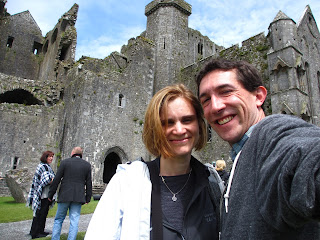
At the Rock of Cashel, an abandoned chapel and cathedral that previously was the home of the Kings of Munster (one of Ireland's four provinces).
That last morning in Ireland, Ryan suggested I ask the hotel clerk for directions to the airport.

As directed, we turned right out of the parking lot and then went left at the stoplight and were supposed to follow the highway signs from there.

That advice landed us in a private Dublin residential neighborhood and facing an Irish version of a "No outlet" sign.

Ryan grumbled mightily as he reversed. "The Irish make great beer," he said. "But they sure need lessons in signage and directions."

Wednesday, July 2, 2014

The donkeys of Venice

Venice reminds me of an adult version of Pleasure Island - that super happy fun-land carnival in the Disney version of Pinocchio. You know, where Pinocchio and the other boys go and play games and eat candy before getting turned into donkeys.

Venice is beautiful. It has wonderful food and tasty sweets. It has lots of shopping. It has roving bands of musicians waiting to serenade lovers, and around every corner you'll find gondoliers whose sole job is to ferry people through the canals past the stunning pastel buildings.

On Rialto Bridge during our first afternoon in Venice.

View of the canals.

A building Ryan particularly liked.

Because of all that, it’s infested with so … many … tourists.

It's Venice. There has to be a bridge shot. Surprisingly, there are no tourists on it.

We overheard a rather ridiculous conversation among these American tourists, who felt people would be more likely to stare at them if they removed their masks.
We enjoyed our first afternoon and night in Venice, walking around and taking in the sights and tastes of the city. We enjoyed our second day exploring the historic Doge’s Palace, St. Mark’s Square and settling in to watch Italy get eliminated by Uruguay at an outdoor patio restaurant.

Then, on the third day, Venice made asses out of us.  

We made a series of bad decisions and assumptions that turned out to be wrong. For instance, we didn't find a place for breakfast – at least in the area we started out exploring. By the time we had something to eat and I had my necessary coffee, it began to pour down rain, dampening our enthusiasm for taking a ferry out to the island of Murano that is known for its glass. We felt equally drowned by the water and tourists in fluorescent ponchos.

Even the gondoliers had their umbrellas out.

Then we got lost.

Rick Steves, whose advice for traveling Europe has generally been invaluable to us, suggested we get lost in Venice to explore off the beaten track. Let’s just say, we can put a big ol’ check mark next to this one. We couldn’t not get lost. The Venetians apparently hated straight lines. What resulted is a hodgepodge of alleys and bridges and dead ends and no signs.

On  my way down one of the narrow alleys. 

Well, there were a few signs. Just not ones that helped us get back on track.

In fact, Venice can be cruel. It’s like a giant rat maze for humans where the gods like Zeus look down and laugh at the stupid humans who kept turning down alleys that terminated at canals (us)  or who made turn after turn only to end up at the same restaurant they left 25 minutes earlier (also us).


The lunch restaurant. I didn't believe Elizabeth when she told me that's where we had eaten.
Eventually, we found an interesting bookstore with steps and walls made of books stacked like bricks and an eccentric shopkeeper named Luigi.

Elizabeth found the staircase of books a good solution (but still a little horrifying to destroy those books).

Books filled both boats and bathtubs.
The proprietor.


Then we got lost again.

Consulting the map for the umpteenth time.
Finally, when we tried to leave the island after a nice dinner, it made it as difficult as possible. The regular trains back to Mestre, where our hotel was, stopped running at 10:30. It was 11:25. We got tickets for a bus ride. But we couldn't find the bus station (what did I tell you about no signs). So we bought tickets for a late train to Rome that went through Mestre.

Let's just say the 12:08 train from Venice to Rome was no midnight train to Georgia. It was one of those trains with compartments of six seats -- three facing three. Elizabeth and I had to settle for seats in different compartments. When she tried to go into hers, a woman who was sleeping in one of the seats glared at her and threw the curtain shut. Elizabeth took my seat, and I sat on one of the pull down seats in the hallway, where I could watch the drama as two families argued over the fact that they had the same seats. The train sat for what felt like an eternity but probably only took off 10 minutes late. It was not humanity at its best, let me tell you.

But it was a fitting ending to our day in Venice.