It might be easy to forget when reading
earlier posts, but I am, in fact, in Ireland to study. And during the course of doing one of my assignments, I seemed to have a coincidental encounter that I can't quite explain but for which I am quite grateful.
 |
| The Proclamation. |
You see, in addition to getting a heavy dose of writers like James Joyce and W.B. Yeats, we're also studying the 1916 Easter Rising. That rebellion came after seven poets, writers and labor leaders drafted the
Proclamation of the Irish Republic – the Irish equivalent of the Declaration of Independence – and
Patrick Pearse read it from steps of the General Post Office building April 24, 1916.
The document called for a provisional government of the Irish Republic – an illegal move in the eyes of the occupying British, which led to violence. And despite fierce resistance by about 1,300 members of the
Volunteer Irish Army throughout Easter week, the Brits sent reinforcements and ultimately crushed the rebels.
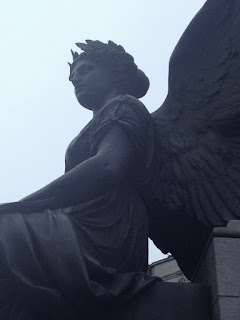 |
| Look at this angel's elbow. It has a bullet from 1916. | |
|
Then, as occupying forces so often do, the British overplayed their hands. They executed the leaders of the rebellion, including signatories of the Proclamation. That aroused the sympathies and outrage of a nation, and after the Irish war of independence in 1922, the southern 2/3 of the island became its own country.
So, with that context, each of us got to select a prominent player in the Rising. I chose Joseph Mary Plunkett, one of the signatories of the proclamation, an organizer of the rising, a poet and former editor of the literary publication
The Irish Review.
Our assignment was to write a blog post to provide a little sketch about our person. I gravitated toward Plunkett because he was a kind of journalist. Then he kept getting more interesting the more I read about him. But I couldn't find many of his own writings.
 |
| Straight out of The Neverending Story. |
When we got to Galway on Thursday, we had time to wander the shops downtown, so I walked into
Charlie Byrne's bookshop in search of a book by Frank O'Connor, the writer on whom I'm doing my final project. I perused the wall of Irish books, many of them used, some of them decades old. No luck.
So I went through the rest of the bookshop. After about 20 minutes, I thought about leaving. But something seemed to nag at me. I went back to that Irish book section and started looking at the lower shelves. That's when, to my astonishment, I found an original copy of the book of Plunkett's poems published in 1916 – after his execution.
 |
| Not bad for 20 Euros, huh? |
It's full of his poems and an essay he wrote in 1914 while editing
The Irish Review. And Plunkett's sister, Geraldine Plunkett, wrote the foreword and not only gave her brother's biography but also critiqued his work, including a succinct, no-nonsense review of Joseph's first book of poems. ("Although there are a good many immature and defective poems in it, it is rather remarkable for a first book." That's some sibling honesty.)
When I brought it up to the register, the shopkeeper said he was so glad to see someone buy it. He said he had recently come into possession of it and brought it to a book fair in Dublin the previous weekend thinking that someone would surely snap it up amid the 100th anniversary of the Rising. He said he was close to selling to someone, but the prospective buyer backed out.
"It must be meant to be for you then," he told me.
I don't know that I believe in fate, but I certainly believe in good (true) stories.


