Showing posts with label Dublin. Show all posts

Friday, July 1, 2016

Interview with a cab driver: Making sense of Irish sports edition

When taxi drivers in the United States discuss hurling, it's usually in the context of "please don't inside the cab."

In Ireland, it's more likely that the topic is the sport of hurling (although the former still applies.)

Early on during my studies in Ireland, we had to take taxis from the University College Dublin one afternoon because a marathon had shut down the main road and all bus service from UCD. As a result, I and the others in the taxi were treated to an incredibly valuable introductory tutorial about Irish sports – and diplomacy – from our cab driver, Michael.

A shot of a hurling match we watched at Galway pub.
For instance, he called hurling the "fastest game on turf" – a brilliant blend of lacrosse, football (soccer), field hockey, rugby and possibly a few other sports thrown in there too. The sticks looked like sawed off field hockey sticks and they can whip a baseball-sized leather ball at 90 mph. There is some combination of passing and blocking and scrum-like pile-ups. And a team can score by hitting the ball through field-goal uprights (one point) or into a soccer-like goal below the uprights (three points).

He wasn't kidding. While we were in Galway, a group of us went to a pub and caught the second half of a hurling match between Dublin and Kilkenny after which I decided the sport got its name from the fact that bats, balls and elbows are being hurled in all directions all the time. The field is huge and the players will randomly hit the ball toward the uprights from literally anywhere on the field. One Kilkenny player cracked one from three-quarters of the field away dead-center through the uprights. There are rules about passing and dribbling that I don't understand yet.

Even if the TV weren't blurry, I still would struggle to explain it.
The other prominent Irish sport is Gaelic football. Like hurling, it's played with a soccer goal/field goal combination (one point for kicking the ball through the uprights, three points for a goal).

The scores in both sports, by the way, require some math because the format separates goals from field goals. For instance, in the Dublin-Kilkenny hurling match, Kilkenny had 1-25 (one goal and 25 field goals) to Dublin's 0-16. So actually, Kilkenny won in points 28-16. It took us a while to figure that out.

In Gaelic football, the rules about dribbling and passing and how many steps you can take are equally obtuse.

Michael, our cab driver, played for Dublin's top club, the Kilmacud Crokes and said some of the sport remains a mystery to me. "I played for nearly 30 years, and I still don't understand all the rules," he said. All the Gaelic football and hurling players are amateurs, he said. "But they're totally committed and train as hard as any pro player," Michael told us.

Gaelic football looks a lot like rugby at first, but there are fewer scrums and it seems to put a premium on good passes and the finesse of soccer rather than tackling and blocking of football or rugby.

The two sports experienced a renaissance in Ireland in the late 1800s as Irish nationalism increased. The Gaelic Athletic Association formed as a way to further promote these truly Irish sports and, thus, Irish culture. But for nearly a century, the rules about participating in the GAA were particularly strict. Michael told us that when he was a young player, GAA members were forbidden from playing non-Irish sports, such as rugby or soccer. If they were caught participating in some "foreign" sport, they'd get kicked off their GAA team.

"I still played all the sports anyway," Michael said. "I believe sports are meant to unify, not divide."

So I asked Michael, our philosopher/diplomat/cab driver, whether he and other Irish sports fans root for or against England in big tournaments, such as the Euro 2016 football tournament that's been going on this month.

He laughed. It's a rivalry, he said. "If Ireland were playing England in chess we'd all watch it," he said.

Michael said he has an English friend who roots for Ireland if England isn't playing and once asked him if Michael would root for England after Ireland was eliminated in a European tournament. Michael told him that he would support England right up to the championship game and then would root for the Brits to lose. "It's like big brother versus little brother," he said. And the little brother is tired of seeing the big brother win everything.

But what we've found is that not everyone in Ireland is as generous toward English teams. In fact there was more than a bit of schadenfreude Monday night when England played Iceland in the round of eight of the Euro 2016 championship – a match that Iceland went on to win 2-1. Murphy's Pub in Dingle erupted in cheers as the clock ran out on England.
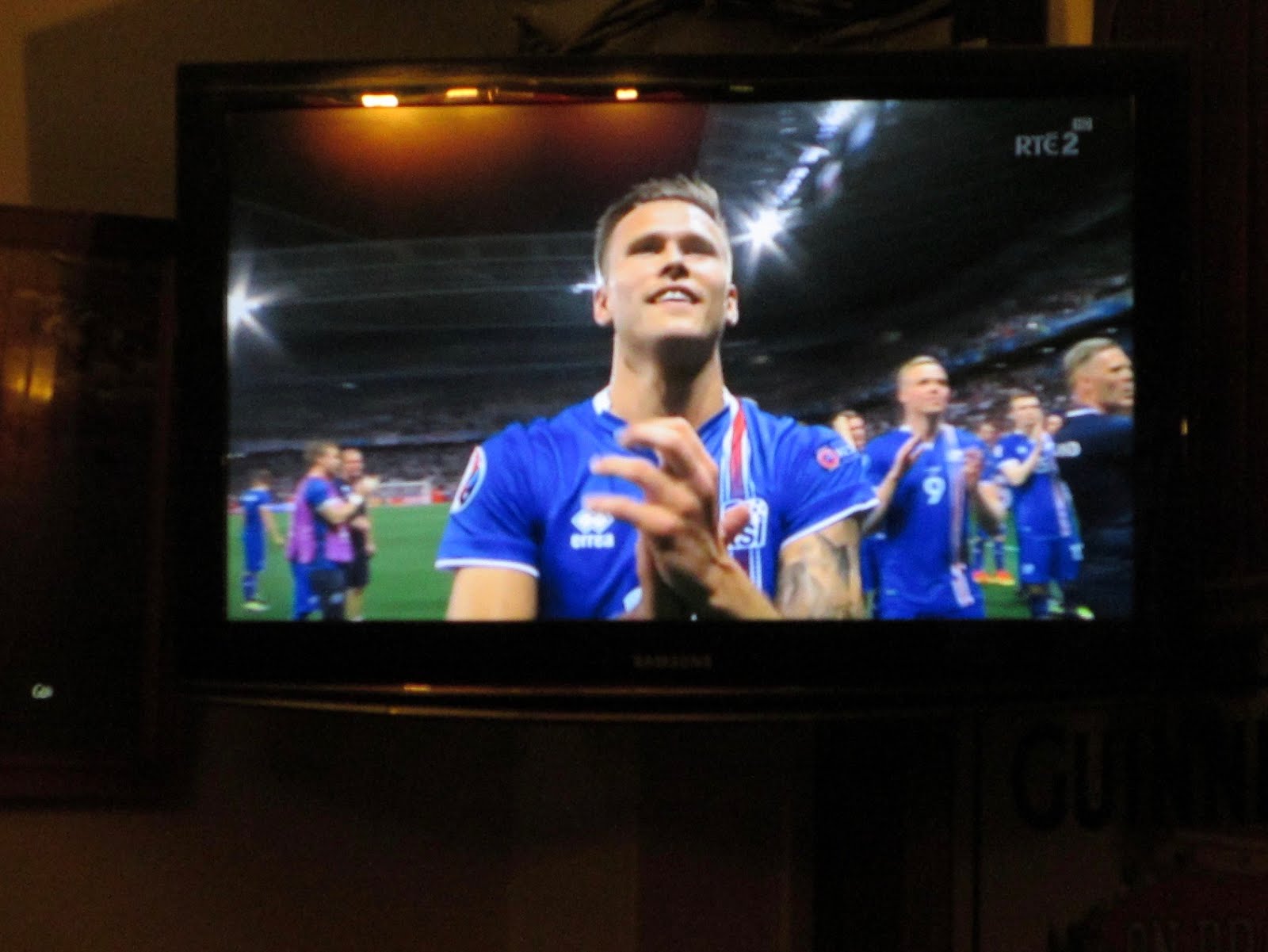
Iceland, which has more volcanoes than people as the commentators kept pointing out, celebrated its upset in style.
My only regret is that we didn't get to see any matches in person, which I contend is a worthy excuse to have to return to Ireland one day.

Saturday, June 25, 2016

We kept running into Joe Biden

Just to show how small a country Ireland is, we kept bumping into Vice President Joe Biden, who was here to not only meet with Irish officials but also explore his family heritage a little bit.

As Elizabeth, Jason and I were looking to get dinner Tuesday, we found the street that ran past Merrion Square and the key government buildings were blocked off. So I asked the Garda – policeman – who told me it was secured for the vice president's visit there that evening.

"That's why there's the barrier. He knew you would be here," the Garda joked with me.

Only people who knew the password could get through. I tried "big teeth" but was wrong. 
The next day we saw more Garda, TV cameras and people in suits blocking off the entrance to a building between the National Library and the Archaeology Museum. (OK, that turned out to be a women's rights rally, so maybe some of these brushes with Biden were in my imagination).

But as we were leaving Dublin on the M50 out of the airport, we saw the world's longest motorcade going in the other direction.
The vice president's motorcade on the other side of the M50.

This was the shot Elizabeth got of the Biden family's car after the string of a dozen or so Garda motorcycles. Can't you see the vice president in the back seat of that SUV?

We did learn that Ciaran Reilly, a historian at Maynooth University, met with Biden to tell him about his family and one of his ancestor's role in helping employ people during the tough times and famine of the mid-19th century. We listened to Reilly's interview on a Kilkenny radio station on the way south from Dublin.

Meanwhile, after being here more than three weeks, I'm still waiting to bump into Bono.

Thursday, June 23, 2016

How we learned so much from an exhibit that's not open yet

(NOTE: This post was adapted from what I first published on our program's blog, Murray State Irish Literature Study Abroad.)

I've heard about so many amazing things to do and see in Dublin that sometimes I forget the details. In our first lecture of the program, an Irish historian, Mary McAuliffe, told us about a special exhibit opening up about the 1916 Easter Rising that would be different than all the other museum displays around the city because it focuses on the 77 women who played key roles in the rebellion but were almost forgotten by history. I thought it would be an ideal starting point for Elizabeth to get into the Easter Rising history.

I might have forgotten that Mary McAuliffe said the exhibit didn't open until June 27. 

The yard at the jail where the Brits executed the rebels.
All I did have stuck in my head was that the exhibit was at the Richmond Barracks, so I took Elizabeth and my fellow graduate student on the trip, Mary Hays, there on Tuesday. The Richmond Barracks sit a half-hour bus ride away amid the Inchicore neighborhood – one hill over from the Kilmainham Gaol (jail), where the British executed the Rising’s leaders.

We had a little trouble finding it (one wrong turn from the bus stop), but eventually located the long building that used to house troops and served as the holding pen and courtroom for rebel leaders after the Brits crushed the Easter week rebellion 100 years ago. 

When we reached, the door, we saw the sign that said it opens June 27. I tried the door anyway.

It was locked, but a woman with sandy hair and big smile opened it up and asked if she could be of help.
She turned out to be Eadaoin Ni Chleirigh, the energetic and enthusiastic executive chair of the 2016 Richmond Barracks exhibition, and graciously gave us a tour.

“You’re from Kentucky? Well if you’re from Kentucky, you must come in,” she said.
Eadoaoin Ni Chleirigh points to the Countess Markievicz panel on the quilt at the Richmond Barracks exhibit.
The main chamber of the barracks, where the 22 rebel leaders were taken after their capture Saturday, April 29, now features displays detailing the contributions of many of the women who helped carry out the rebellion, such as Rose McNamara (who became vice-commandant at the rebels’ outpost at the Marrowbone Lane Distillery), Winifred Carney (top aide to Joseph Connelly) and of course Countess Markievicz, who was a catalyst for the Rising and is the most well-known of the women involved.

A French paper snapped Markievicz being taken by ambulance to the jail.
In all, 77 women are honored on squares of a quilt that hangs in the back of the barrack’s main room.

“Some of these women only had a sentence or two written about them before this,” Chleirigh said.

That made researching them difficult. Chleirigh initially drew Bridget Hegarty to investigate. That meant tracking down family members. It turned out they knew little about her role in the Rising but became so intrigued that Hegarty’s grandniece then took over the research and design of Hegarty’s quilt square.

“When the family discovered what she’d done,” Chleirigh said, “they were so proud of her.”

Many of those stories would have been lost to history had it not been for McAuliffe, the professor who gave us our first history lesson here. She literally wrote the book on them. Much of the information she found through military pension applications the women submitted to the government – sometimes unsuccessfully for decades. That's how McAuliffe learned that her own grandmother served in the 1921 War for Independence, she told us.

The Richmond Barracks display not only features the women but also the stories of the leaders who were held and tried in the barracks before being marched up to the Kilmainham jail where 14 were executed. 

Chleirigh showed us letters written on scrap paper by the father of Joseph Mary Plunkett, one of the rebellion's leaders whom I specifically studied. Plunkett's parents, who had nothing to do with the Rising, were held in the Richmond Barracks for about a week, and his father was asking his daughter to bring supplies, including food and specifically butter.


The view from a window in the barracks after the war for independence as the British troops leave and the Irish troops move in.

She also showed us the rest of the barracks, which were used as a Catholic school for part of the 20th Century.

Elizabeth and Mary check out one of the digital displays.     


Yes, Ireland really is this magical place of hospitality in which even when I screw up and show up at the doorstep of an exhibit that isn't yet open, they welcome us in and give a private tour.

So as they say here in Dublin: Thanks a million!

Wednesday, June 22, 2016

Probably not the best time for a surprise

Ryan was a sweetheart and got up at 3:45 a.m. Monday to meet my flight at the Dublin airport. Cleveland hadn't even won the NBA title at that point. It was a whole different world.

My plane got in at 4:55 a.m., and after the early appearance of my luggage on the conveyor and an extremely quick stop in customs for my Ireland stamp, I was probably outside baggage claim by 5:15.

Ryan said he expected to be there closer to 5:25, so I picked a seat and sat down to read until he arrived. And I waited. And waited.

Finally, about 5:50 I checked my phone and found a text from him that said he'd been there for nearly 15 minutes and was waiting for me to walk through the door. What?

My strategic mistake was not telling Ryan that I had finally, finally cut 6 inches off my hair on Friday. I wanted it to be a surprise, and clearly it was. I waved, yelled his name and finally had to chase him down and grab his arm. He looked at me for several seconds before recognition hit, and a slow smile spread over his face. I'm glad he likes it short, because I much prefer it this way, too.

(As an aside, once Ryan did go to the wrong airport to pick me up. I was visiting him in D.C. and he went to Dulles while I was waiting for him at Reagan. That was 16 years ago, before I had a cell phone. Ryan had to have me paged at the airport to assure me he was not breaking up with me in the cruelest of ways.)

After that, he got us back to the UCD dorm (where we are occupying separate single rooms!) and let me nap while he went to class in the morning. We spent the rest of the day visiting Ryan's favorite places in Dublin with a stop at H&M for me. (That makes Ireland the sixth foreign country where I have visited an H&M.)

Ryan, Thomas Kettle's bust and Elizabeth with short hair.

Sunday, June 12, 2016

Maybe there is something mystical about this island's poetry

It might be easy to forget when reading earlier posts, but I am, in fact, in Ireland to study. And during the course of doing one of my assignments, I seemed to have a coincidental encounter that I can't quite explain but for which I am quite grateful.

The Proclamation.
You see, in addition to getting a heavy dose of writers like James Joyce and W.B. Yeats, we're also studying the 1916 Easter Rising. That rebellion came after seven poets, writers and labor leaders drafted the Proclamation of the Irish Republic – the Irish equivalent of the Declaration of Independence – and Patrick Pearse read it from steps of the General Post Office building April 24, 1916.

The document called for a provisional government of the Irish Republic – an illegal move in the eyes of the occupying British, which led to violence. And despite fierce resistance by about 1,300 members of the Volunteer Irish Army throughout Easter week, the Brits sent reinforcements and ultimately crushed the rebels.

Look at this angel's elbow. It has a bullet from 1916.
Then, as occupying forces so often do, the British overplayed their hands. They executed the leaders of the rebellion, including signatories of the Proclamation. That aroused the sympathies and outrage of a nation, and after the Irish war of independence in 1922, the southern 2/3 of the island became its own country.

So, with that context, each of us got to select a prominent player in the Rising. I chose Joseph Mary Plunkett, one of the signatories of the proclamation, an organizer of the rising, a poet and former editor of the literary publication The Irish Review. Our assignment was to write a blog post to provide a little sketch about our person. I gravitated toward Plunkett because he was a kind of journalist. Then he kept getting more interesting the more I read about him. But I couldn't find many of his own writings.

Straight out of The Neverending Story.
When we got to Galway on Thursday, we had time to wander the shops downtown, so I walked into Charlie Byrne's bookshop in search of a book by Frank O'Connor, the writer on whom I'm doing my final project. I perused the wall of Irish books, many of them used, some of them decades old. No luck.

So I went through the rest of the bookshop. After about 20 minutes, I thought about leaving. But something seemed to nag at me. I went back to that Irish book section and started looking at the lower shelves. That's when, to my astonishment, I found an original copy of the book of Plunkett's poems published in 1916 – after his execution.

Not bad for 20 Euros, huh?
It's full of his poems and an essay he wrote in 1914 while editing The Irish Review. And Plunkett's sister, Geraldine Plunkett, wrote the foreword and not only gave her brother's biography but also critiqued his work, including a succinct, no-nonsense review of Joseph's first book of poems. ("Although there are a good many immature and defective poems in it, it is rather remarkable for a first book." That's some sibling honesty.)

When I brought it up to the register, the shopkeeper said he was so glad to see someone buy it. He said he had recently come into possession of it and brought it to a book fair in Dublin the previous weekend thinking that someone would surely snap it up amid the 100th anniversary of the Rising. He said he was close to selling to someone, but the prospective buyer backed out.

"It must be meant to be for you then," he told me.

I don't know that I believe in fate, but I certainly believe in good (true) stories.

Plunkett's wife Grace drew this picture a month after they married and the British executed Joseph. You can read my blog post about Plunkett on our program's blog, Murray State Irish Literature Study Abroad.